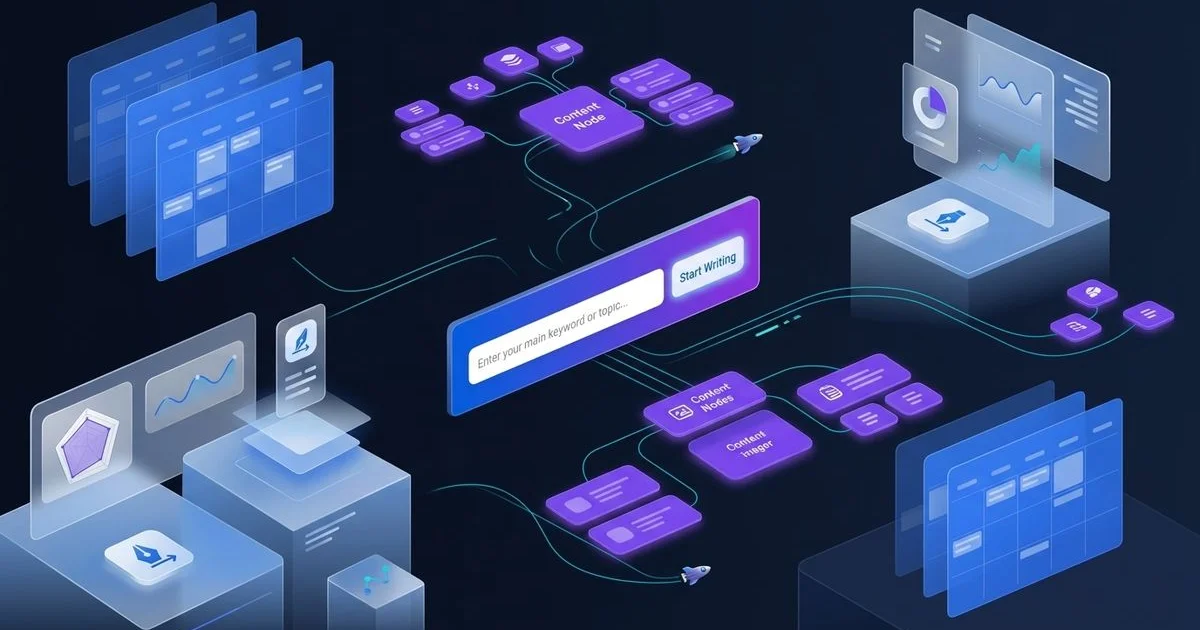
SEO agencies face a unique set of challenges when it comes to content planning. Managing content strategies for multiple clients across different industries requires scalable processes, consistent quality, and efficient resource allocation. An AI SEO writing tool like Agility Writer is transforming how forward-thinking agencies approach these challenges, enabling them to deliver better results with greater efficiency.
This article presents a strategic framework for SEO agencies looking to integrate AI into their content planning workflows.
The Agency Content Planning Challenge
Unlike in-house teams that focus on a single brand, SEO agencies must juggle multiple clients with different industries, audiences, and competitive landscapes. Each client needs a unique content strategy tailored to their specific goals and market position.
The traditional approach to managing this complexity involves dedicated strategists for each client or group of clients, manual keyword research and competitive analysis for every campaign, custom content calendars built from scratch, and individual briefing documents for every article. This approach works but does not scale efficiently. As an agency grows its client base, the overhead of manual content planning grows proportionally, squeezing margins and limiting capacity for new business.
How AI Transforms Agency Content Planning
AI content planning tools address the scalability challenge by automating the research-intensive aspects of content strategy while preserving the strategic thinking that agencies provide.
Automated Competitive Analysis
For each client, understanding the competitive landscape is essential. AI tools can rapidly analyze competitor content libraries, identify topic gaps, and map out the content landscape for any industry. What might take a strategist several days of manual research can be completed in minutes.
Agility Writer’s topical map feature is particularly valuable for agencies because it can generate comprehensive topic maps for any niche. When onboarding a new client in an unfamiliar industry, the topical map provides an instant understanding of what content needs to be created.
Scalable Content Production
Once the content plan is in place, AI writing tools enable agencies to produce content at a pace that matches client expectations without proportionally increasing headcount. Using multiple writing modes, agencies can produce different content types, from blog posts and guides to service pages and comparison articles, tailored to each client’s needs.
For agencies managing high-volume content campaigns, bulk generation capabilities allow entire content calendars to be produced in a fraction of the time manual writing would require.

The Agency AI Content Framework
Phase 1: Client Discovery and Topic Mapping
Every client engagement should begin with a thorough discovery process. AI accelerates this phase without replacing it. Use AI topical mapping to generate an initial content landscape for the client’s industry. Layer in client-specific information such as unique selling propositions, target audiences, and business objectives. Identify competitive gaps where the client can establish authority more quickly. Define pillar topics that align with the client’s products or services.
The output of this phase is a comprehensive topical map that serves as the strategic foundation for all content activities.
Phase 2: Content Prioritization
Not all content in the topical map is equally valuable or urgent. Prioritization should consider the client’s immediate business goals, keyword difficulty relative to the client’s current domain authority, traffic potential based on search volume and click-through rate data, and content that supports the client’s sales funnel.
For clients focused on building topical authority, prioritize completing entire topic clusters rather than cherry-picking individual high-volume keywords. A complete cluster builds authority faster than scattered individual articles.
Phase 3: Production Planning
With priorities established, plan the production schedule. Consider how many articles can be produced per month given the budget, the optimal publishing frequency for the client’s domain, dependencies between articles where pillar content should precede cluster content, and seasonal considerations for time-sensitive topics.
AI tools help agencies produce content more efficiently, but production planning ensures that efficiency translates into strategic impact rather than undirected output.
Phase 4: Content Generation and Quality Control
Generate content using AI tools configured with the client’s brand voice, target audience, and content specifications. Establish a quality control process that includes AI-generated first drafts, human review for accuracy and brand alignment, SEO optimization using tools like the Gsmart Optimizer, client approval where required, and final editing and formatting.
This hybrid approach leverages AI speed while maintaining the quality standards that agencies must uphold.
Phase 5: Performance Tracking and Iteration
After content is published, track performance against the goals defined in Phase 1. Use performance data to refine the content strategy, identifying which topics and formats drive the best results for each client. Update the topical map based on new opportunities and changing competitive landscapes.
Managing Multiple Client Strategies
Templated Workflows
Create templated workflows that can be adapted for each client. The core process of topic mapping, prioritization, production, and measurement remains the same. What changes are the specifics of each client’s industry, competitive landscape, and business objectives.
Templates ensure consistency across your agency while allowing customization where it matters.
Knowledge Separation
When using AI tools across multiple clients, maintain strict separation of client knowledge and strategies. Each client’s content plan should be treated as an independent project with its own topical map, keyword targets, and competitive analysis. Never reuse content across clients or apply one client’s strategy to another without thorough customization.
Reporting and Communication
AI tools generate performance data that can be compiled into client reports. However, raw data is not enough. Agencies add value by interpreting data in the context of the client’s goals, providing strategic recommendations based on performance insights, and explaining the rationale behind content decisions.

Pricing AI-Powered Content Services
One of the most common questions agencies face is how to price content services that leverage AI tools. Several models work depending on your agency’s positioning.
Value-based pricing focuses on the results delivered rather than the effort involved. If AI helps you deliver better results more efficiently, you capture part of that efficiency as improved margins while passing part of it on to clients through better performance.
Tiered packages offer clients different levels of content production at different price points. AI enables you to profitably offer higher-volume packages that would have been cost-prohibitive with manual production alone.
Performance bonuses tie a portion of your compensation to measurable outcomes like traffic growth or ranking improvements. AI’s ability to produce more optimized content more efficiently increases the likelihood of achieving performance targets.
The key is to price based on the value of the output, not the cost of the input. AI reduces your production costs, but the value of well-optimized content that drives traffic and conversions has not decreased.
Building Your Agency’s AI Competency
Integrating AI into your agency’s content planning is not just a technology decision. It requires developing new competencies across your team.
Strategists need to learn how to leverage AI topical mapping tools and translate AI-generated insights into client-specific strategies. They should understand the capabilities and limitations of AI content tools to set appropriate expectations.
Content producers need training on effective AI tool usage, including prompt engineering, output evaluation, and the editing skills specific to refining AI-generated content.
Account managers need to understand AI’s role well enough to communicate confidently with clients about the agency’s content process and the quality controls in place.
Handling Client Concerns About AI Content
Some clients may have concerns about AI-generated content. Address these proactively by explaining your quality control process that ensures every piece meets human editorial standards. Share examples of AI-assisted content performing well in search results. Emphasize that AI handles the research and drafting while human experts provide strategy, oversight, and brand-specific refinement. Reference Google’s stated position that AI content is acceptable as long as it is helpful and high quality.
Transparency about your process builds trust. Most clients care about results, and when they see the performance data, concerns about the production method fade.
Scaling Your Agency with AI
AI content planning tools enable agencies to scale in ways that were previously impossible without proportional headcount growth. A team of five strategists and editors can manage the content output that previously required a team of twenty writers. This scalability translates directly to improved agency economics.
Consider how AI changes your capacity. More clients can be served without proportionally increasing staff. Higher-volume content packages become profitable to offer. Faster turnaround times become feasible. Resources can be reallocated from production to strategy and client relationships.
The agencies that master AI-powered content planning will have significant competitive advantages in the marketplace, both in terms of the results they deliver and the efficiency with which they deliver them.

Getting Started
If your agency is ready to integrate AI into its content planning workflow, start with a pilot program. Select two or three clients with straightforward content needs and apply the framework outlined above. Measure the results against your traditional approach in terms of both quality and efficiency.
Explore Agility Writer’s agency-friendly features including topical mapping, bulk generation, and optimization tools. Visit our pricing page to find a plan that matches your agency’s scale and ambitions.
The future of agency content services is AI-augmented. The question is not whether to adopt AI tools but how quickly and effectively you can integrate them into your workflow.