Google’s E-E-A-T framework, standing for Experience, Expertise, Authoritativeness, and Trustworthiness, has become the quality benchmark against which all content is measured. For AI-generated content, meeting E-E-A-T standards requires deliberate effort because the signals that demonstrate genuine human expertise do not appear automatically in AI output. Using an AI SEO writer that understands these quality signals is a critical first step.
This playbook covers practical strategies for injecting authentic E-E-A-T signals into AI-generated articles, ensuring your content meets Google’s quality standards while maintaining the efficiency benefits of AI writing.
What E-E-A-T Means for AI Content in 2026
Google’s Quality Rater Guidelines use E-E-A-T as a framework for evaluating content quality. While E-E-A-T is not a direct ranking factor, it influences how Google’s algorithms assess content helpfulness, which does affect rankings.
The addition of the first “E” for Experience was particularly significant for AI content. Google explicitly values first-hand experience as a quality signal, which is something AI inherently cannot provide on its own. This does not mean AI content cannot rank well, but it means AI content must be enhanced with genuine experiential elements to compete effectively.
In 2026, the E-E-A-T framework continues to be central to Google’s quality assessment. Sites that demonstrate strong E-E-A-T signals across their content enjoy more stable rankings and better resilience against algorithm updates. For AI-assisted content operations, building these signals systematically is not optional; it is essential.
Experience: Adding First-Hand Insights to AI Articles
The Experience component evaluates whether the content demonstrates first-hand knowledge of the topic. For AI-generated articles, this means augmenting the AI output with genuine human experience.
Personal anecdotes and case examples are the most direct way to demonstrate experience. After generating an article with Agility Writer, add specific examples from your professional practice. If you are writing about SEO strategies, include a brief account of how a particular approach worked for a real project.
Specific details that only an experienced person would know signal authenticity. Instead of generic advice like “track your results,” add details like “in our experience, the ‘Queries’ report in Google Search Console surfaces the most actionable data within the first 28 days of publishing a new topic cluster.”
Practical tips and warnings from real experience differentiate your content from purely theoretical articles. Noting that “this approach works best for sites with domain authority above 30” or “we found diminishing returns after 40 articles per cluster” adds the kind of practical nuance that AI cannot generate from training data alone.
Agility Writer’s first-hand experience feature allows you to input your own experiential data points that the AI weaves naturally into the generated content, making the process more efficient than manual post-editing.

Expertise: Demonstrating Subject Matter Knowledge
Expertise is demonstrated through depth of coverage, accurate use of industry terminology, and comprehensive treatment of a topic’s nuances.
AI tools like Agility Writer that perform SERP analysis and entity extraction naturally produce content with strong expertise signals. The entity coverage ensures that articles mention the concepts, terms, and relationships that experts in the field would include. The Gsmart Optimizer further evaluates whether the content meets the depth standards that Google expects for the topic.
Beyond what AI generates automatically, strengthen expertise signals by ensuring all technical claims are accurate and verifiable. Cross-reference statistics, dates, and factual assertions. Incorrect information is the fastest way to undermine expertise signals.
Use custom knowledge uploads in Agility Writer to feed the AI system with your proprietary research, unique data, or specialized knowledge. This produces content that reflects genuine expertise rather than repackaged common knowledge.
Authoritativeness: Building Topical Authority Signals
Authoritativeness is evaluated at both the page level and the site level. It reflects whether your site is recognized as a go-to resource in your topic area.
At the site level, authoritativeness is built through comprehensive topical coverage. A site with fifty well-linked articles on a topic signals more authority than a site with five. This is where Agility Writer’s topical map feature provides strategic value, ensuring your content covers the full landscape of your topic area systematically.
At the page level, authoritativeness signals include proper author attribution with credentials, citations of authoritative sources, and internal links that connect the page to your broader body of expertise on the topic.
Build author pages that detail credentials, experience, and published work. Link these author pages from every article. Google’s systems evaluate author reputation as part of E-E-A-T assessment, and well-structured author pages strengthen this signal across all your content.
For more on building topical authority strategically, read our guide on gaining topical authority with AI.
Trustworthiness: Citations, Sources, and Accuracy
Trustworthiness encompasses accuracy, transparency, and reliability. For AI-generated content, this requires specific attention because AI can confidently generate incorrect information.
Cite authoritative sources for statistical claims, research findings, and industry data. Link to original studies, official documentation, and recognized industry resources. AI-generated content should be reviewed to verify that all cited information is accurate and that source links point to legitimate, authoritative pages.
Disclose clearly when content is AI-assisted. While Google does not require AI disclosure for ranking purposes, transparency builds reader trust. A brief note that content was “researched and drafted with AI assistance, reviewed and enhanced by [author name]” is honest and builds confidence.
Maintain factual accuracy rigorously. Implement a review process where every AI-generated article is fact-checked before publication. Pay particular attention to numbers, dates, product specifications, and legal or medical claims that could cause harm if incorrect.
Include proper contact information and about pages on your site. Google’s quality guidelines specifically mention that sites should have clear contact information and transparent ownership as trust signals.

Using Agility Writer’s E-E-A-T Features
Agility Writer includes several features specifically designed to help build E-E-A-T signals in generated content.
The first-hand experience input allows you to provide personal anecdotes, case study data, and practical insights that the AI incorporates into the article naturally. This addresses the hardest E-E-A-T component for AI content by making experience integration part of the generation process rather than a manual post-editing step.
Custom knowledge uploads let you feed proprietary data, research, and specialized information to the AI. Content generated with custom knowledge reflects genuine expertise that cannot be replicated by competitors using the same AI tool with default settings.
The writing modes include options optimized for different E-E-A-T requirements. Advanced mode provides the deepest entity and topical coverage for expertise signals. Product review mode structures content with the comparison elements and specific assessments that demonstrate evaluative experience.
G-Smart Alignment With Quality Rater Guidelines
The Gsmart Optimizer evaluates your content against the principles in Google’s Quality Rater Guidelines. It checks for depth of coverage, topical completeness, structural quality, and potential issues that could weaken your E-E-A-T signals.
Running every article through G-Smart before publication creates a quality floor that prevents weak content from reaching your site. This is particularly important for bulk content operations where the risk of quality variation is higher. A single low-quality article may not trigger a site-wide quality downgrade, but a pattern of thin content can affect all your pages.
A Practical E-E-A-T Enhancement Workflow
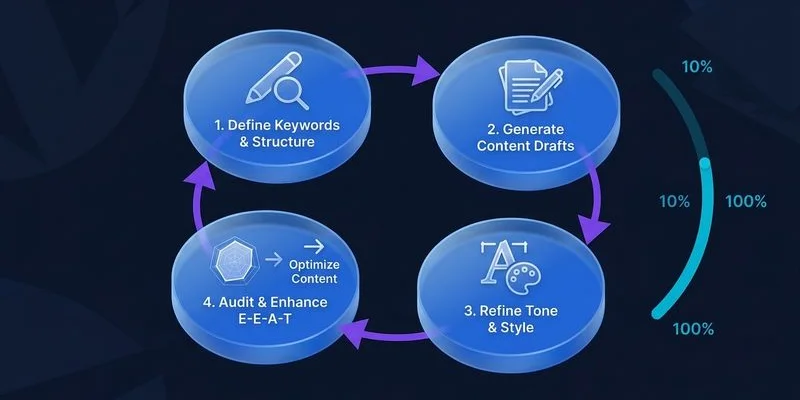
Integrate E-E-A-T enhancement into your content workflow rather than treating it as an afterthought. Before generating content, prepare your experience inputs and custom knowledge relevant to the topic. During generation, use the appropriate writing mode and provide your experiential data points. After generation, review for accuracy, add citations to authoritative sources, and verify that the author attribution is properly configured. Before publishing, run the article through G-Smart optimization and make final adjustments.
This workflow adds fifteen to twenty minutes per article compared to publishing raw AI output, but the investment in E-E-A-T quality translates directly to better ranking performance and more stable search visibility.
Explore Agility Writer’s full suite of features and pricing plans designed to help you produce AI content that meets the highest quality standards Google expects.