
Programmatic SEO is the practice of creating large numbers of targeted landing pages systematically, using templates and data to generate unique content for each page. When executed well, it captures enormous volumes of long-tail search traffic that would be impractical to target with individually written articles.
AI-powered SEO writing has made programmatic SEO dramatically more effective. Where traditional programmatic pages often suffered from thin, template content that barely varied between pages, AI-generated programmatic content can produce genuinely unique, comprehensive articles for each target variation. This guide covers the complete strategy.
What Is Programmatic SEO and When to Use It
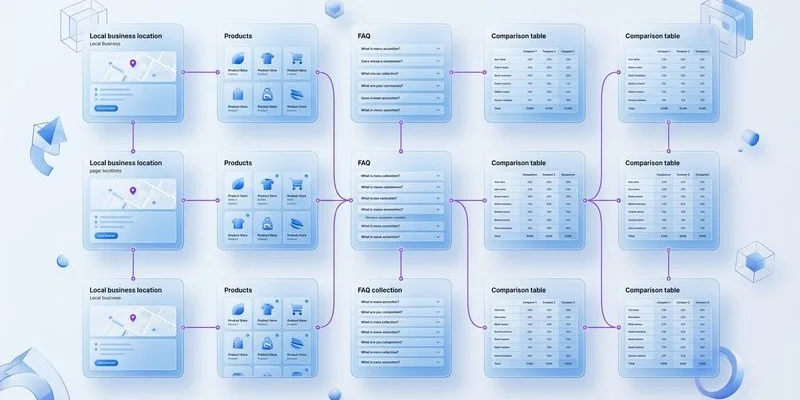
Programmatic SEO works best when you have a repeatable content format applied across many variations. Common examples include location-based service pages like “plumber in [city]” for hundreds of cities, product comparison pages like “best [product] for [use case]” across multiple products and uses, price comparison pages such as “[service] cost in [location]” for different markets, and niche directory pages like “[profession] near [neighborhood]” across metropolitan areas.
The common thread is a consistent template applied across a large variable set. If you can define the format once and the variables provide meaningful differentiation between pages, programmatic SEO is a viable strategy.
The approach is not suitable for topics where each page requires genuinely different expertise or analysis. It works best for information that varies predictably across known dimensions like location, product, or use case.
Types of Programmatic Pages
Local Service Area Pages
The most common programmatic SEO application is local service pages. A plumbing company that serves fifty cities needs a dedicated page for each city to rank in local search results. Each page follows the same structure but includes city-specific information like local landmarks, service area details, and community references.
Product Category Pages
E-commerce and affiliate sites use programmatic SEO to create landing pages for every product category and subcategory combination. “Best running shoes for flat feet,” “best running shoes for trail running,” and “best running shoes under $100” each deserve their own page.
Niche Information Pages
Information sites create programmatic pages around systematic data variations. “Average salary for [job title] in [city],” “[university] acceptance rate,” or “[medication] side effects” are all examples of niche information programmatic strategies.
Data Sources for Template Variables
Effective programmatic SEO requires reliable data sources for your template variables. The quality of your input data directly determines the quality of your generated pages.
Location data can come from census databases, geographic APIs, or curated city and neighborhood lists. For local SEO programmatic campaigns, include population, notable landmarks, nearby areas, and local economic data alongside the basic city name.
Product data comes from manufacturer specifications, API feeds from retailers, or manually curated product databases. The more attributes you include per product, the more unique and valuable each generated page can be.
Industry data such as salary figures, statistics, or pricing information should come from authoritative sources and be regularly updated. Stale data in programmatic pages is a common quality issue.
Structure your data in a clean spreadsheet or database format with one row per page variation and columns for each variable that will be inserted into your content template.
Using Bulk Mode for Programmatic Content
Agility Writer’s bulk generation feature is purpose-built for programmatic SEO campaigns. It accepts your list of target topics and generates unique articles for each one in a single batch operation.
The critical advantage over traditional template-based programmatic SEO is that each article is generated independently by the AI, using your topic and variables as inputs. This means each page has genuinely unique content, different sentence structures, varied examples, and distinct perspectives on the topic, even though they all follow the same general format.
Prepare your bulk generation input by creating a spreadsheet with one row per target page. Each row should include the complete article title with variables filled in, the primary target keyword, and any specific instructions or data points to include. Upload this to Agility Writer’s bulk generation interface and configure your writing mode and quality settings.
Template-Based Generation With Advanced Mode
For campaigns where you need more control over the output structure, Agility Writer’s advanced writing mode allows you to define a detailed content template that the AI follows for each variation.
Define your template with specific sections, heading structures, and content requirements. For a local service page template, you might specify sections for local area overview, services available, pricing factors specific to the area, customer testimonials from the area, and a location-specific call to action.
The AI follows your template structure while generating unique content for each location or variation. This ensures consistency in the user experience while maintaining the uniqueness that search engines require.
Ensuring Uniqueness Across Hundreds of Pages
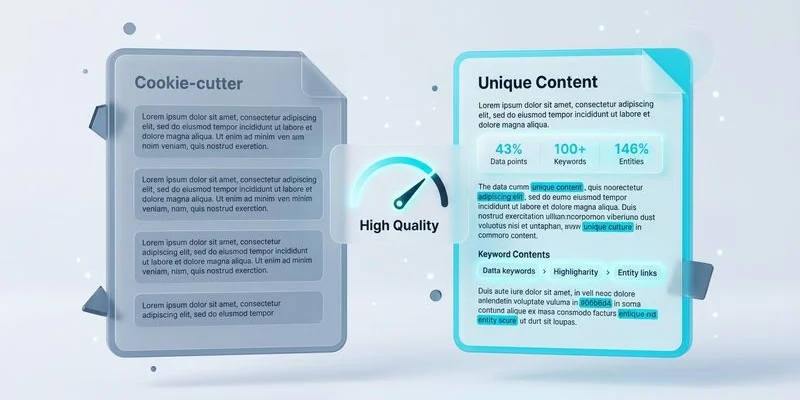
The biggest risk in programmatic SEO is creating pages that are too similar to each other. Google’s algorithms detect near-duplicate content and may consolidate or demote pages that do not provide unique value.
AI generation naturally introduces variation, but additional measures help ensure sufficient uniqueness. Provide different data inputs for each page variation, not just the location or product name but supporting data like population, climate, demographics, or product specifications. Vary the content angle based on the variable. A page about “plumber in Miami” should reference different concerns than “plumber in Minneapolis” because the local context genuinely differs. Use conditional sections that appear only when relevant data is available. A location page for a coastal city might include information about salt water plumbing issues, while an inland city page omits that section.
Review a sample of generated pages side by side to assess uniqueness before publishing the full set. If pages read too similarly, enrich your input data with more variable-specific details.
Internal Linking for Programmatic Page Sets
Large sets of programmatic pages need a clear internal linking strategy to avoid creating hundreds of orphan pages.
Create a hub page that links to all programmatic pages within a category. For local service pages, this might be a “Service Areas” page that lists and links to every city page. For product pages, a category index serves the same purpose.
Within the programmatic pages themselves, include contextual links to related variations. A page about “plumber in downtown Miami” should link to “plumber in Miami Beach” and “plumber in Coral Gables.” These cross-links help search engines crawl the full set and understand the relationships between pages.
Also link programmatic pages back to your main pillar content. Local service pages should link to relevant service description pages, and product pages should link to buying guides and comparison articles. This integrates your programmatic content with your broader site architecture.
For more on building effective link structures, read our guide on internal linking strategy for topical authority.
Indexing Strategy: Avoiding Thin Content Flags
Publishing hundreds of pages simultaneously can overwhelm Google’s crawl budget and trigger quality reviews. Deploy programmatic pages gradually using a staged indexing approach.
Start by publishing and indexing your hub pages and a small sample of the strongest programmatic pages. Monitor indexing rates and ranking performance for this initial set. If Google indexes them quickly and rankings are stable, expand the published set in batches.
Use XML sitemaps to prioritize which pages crawlers should discover first. Submit sitemaps in batches rather than including all pages at once. This gives search engines time to process and evaluate each batch before encountering the next.
For pages that do not get indexed after several weeks, evaluate their quality. Pages that Google chooses not to index are sending a signal that they do not provide sufficient unique value. Enhance these pages with additional data, unique content sections, or consolidate thin variations into broader pages.
Agency Use Case: Local SEO Service Area Pages
SEO agencies frequently use programmatic SEO to build service area pages for local business clients. A single client might need pages for fifty to two hundred locations, each optimized for “[service] in [location]” searches.
The workflow for agencies involves collecting the client’s service area data including cities, neighborhoods, and zip codes they serve. Enriching each location with local data that makes pages genuinely useful. Generating unique content for each location using bulk generation. Reviewing a sample for quality and local accuracy. Publishing with proper internal linking to the client’s main service pages.
For agencies managing this process across multiple clients, Agility Writer’s content planning framework and pricing structure support high-volume programmatic campaigns efficiently.