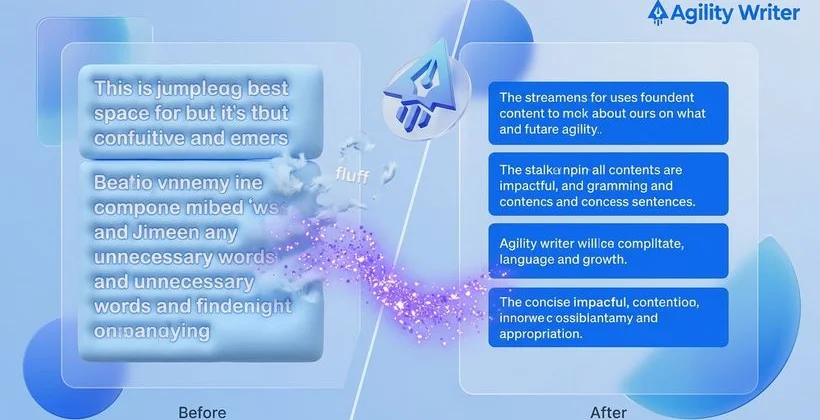
What Is AI Writing Fluff?
AI writing fluff refers to filler content generated by artificial intelligence that adds word count without adding value. It includes vague generalizations, redundant statements, unnecessary transitional phrases, and surface-level observations that any reader could figure out on their own. Fluff is the difference between an article that teaches something and an article that simply occupies space on a page.
Every AI language model has a tendency to produce fluff because these models optimize for fluency and coherence, not information density. When a model does not have specific knowledge to draw on, it fills the gap with broad statements that sound authoritative but communicate nothing concrete. Phrases like "In today's digital landscape," "It is important to note that," and "There are many factors to consider" are classic examples of AI fluff that plague auto-generated content.
The problem is not that AI cannot write well. Modern language models produce remarkably coherent prose. The problem is that coherence without substance is worse than no content at all. Google's Helpful Content Update specifically targets pages that exist to rank rather than to help users. Fluff-heavy content is exactly the kind of material that update penalizes.
Why AI Tools Produce Filler Content
Understanding why AI generates fluff helps you prevent it. Language models predict the most likely next token based on their training data. When generating content on a topic they have limited training data for, or when prompted to write longer articles, models default to safe, generic patterns. They pad articles with introductory context that repeats the heading, restate conclusions in slightly different words, and insert transitional sentences that add zero information.
Prompt engineering plays a significant role. A prompt that says "write a 2,000-word article about email marketing" incentivizes the model to hit a word count target, which naturally produces padding. Better prompts specify the subtopics to cover, the depth expected for each section, and the audience's knowledge level. Agility Writer handles this automatically by generating detailed outlines from SERP analysis before drafting, ensuring every section has specific, substantive content to deliver.
Another factor is the absence of real-world data. Generic AI writers produce content from their training data alone. They cannot verify current statistics, check recent developments, or incorporate live competitive analysis. This forces them to rely on vague claims rather than specific facts. SERP-informed AI tools like Agility Writer solve this by grounding content generation in actual search results, pulling in the specific entities, data points, and subtopics that top-ranking articles cover.
Common Fluff Patterns to Watch For
Learning to recognize fluff patterns makes editing faster and more effective. Here are the most common ones found in AI-generated SEO content:
- The empty opener: Sentences like "In today's fast-paced world" or "As we all know" that contribute nothing to the topic.
- Heading restatement: The first sentence of a section simply rephrases the heading. If your H2 is "Benefits of Email Segmentation" and the first sentence says "Email segmentation offers many benefits," that is pure fluff.
- Hedge stacking: Excessive qualifiers like "it might be possible that in some cases, certain strategies could potentially help improve results." Be direct. State what works and why.
- Circular reasoning: "Content marketing is important because it helps with marketing your content effectively." The sentence restates itself without adding information.
- Generic conclusions: Ending every section with "In conclusion, this is an important topic that deserves careful consideration." Cut these entirely.
- Filler transitions: "Now that we've discussed X, let's move on to Y." The heading already signals the transition.

How Fluff Impacts SEO Rankings
Google measures content quality through several signals that fluff directly undermines. Dwell time drops when readers encounter paragraphs that do not teach them anything new. Bounce rates increase when visitors realize an article is padding rather than substance. And the Helpful Content system evaluates whether a page provides genuine value or exists primarily to capture search traffic.
Fluff also dilutes your keyword relevance. When half your article is filler, the topical density of your target keywords and related entities decreases. A 2,000-word article with 1,000 words of substance and 1,000 words of fluff ranks worse than a focused 1,200-word article that covers the same topic more densely. Google does not reward word count. It rewards information coverage per page.
Additionally, internal linking becomes less effective when your content lacks genuine subtopics to link between. Fluff sections cannot serve as meaningful anchor targets because they do not cover specific concepts worth referencing from other pages.
How to Detect Fluff in Your Content
The simplest detection method is the deletion test. Read each sentence and ask: "If I delete this sentence, does the reader lose any information?" If the answer is no, the sentence is fluff. Apply this test paragraph by paragraph, and you will quickly identify which sections need rewriting versus which can be cut entirely.
Another effective technique is the specificity check. Highlight every sentence that contains a specific fact, number, example, or actionable instruction. Everything not highlighted is a candidate for fluff. High-quality SEO content typically has 70% or more of its sentences containing specific, verifiable information.
Watch for paragraphs that could apply to any topic. If you can swap your subject for a completely different topic and the paragraph still makes sense, it is too generic. "Understanding your audience is crucial for success" applies to everything from cooking to cryptocurrency. Replace it with something specific to your actual topic.
How Agility Writer Minimizes Fluff
Agility Writer is engineered to reduce fluff at every stage of content generation. The system starts with live SERP analysis, which gives the AI specific subtopics, entities, and content structures to work with. Instead of generating from a vague prompt, the model works from a detailed outline that specifies exactly what each section needs to cover.
The G-Smart Optimizer evaluates generated content against Google's quality guidelines, flagging sections that lack substance or specificity. Entity coverage analysis ensures your article mentions the specific concepts, brands, technologies, and data points that top-ranking competitors include. This data-grounded approach produces content with higher information density by default.
For teams that need additional polish, the Advanced Mode gives you full control over the outline before generation begins. You can add, remove, or modify sections to ensure every part of the article serves a purpose. Combined with post-generation editing in the built-in editor, you have complete control over content quality while still benefiting from AI speed.
Practical Steps to Eliminate Fluff
- Use SERP-informed generation: Tools like Agility Writer that base content on real search data produce substantially less fluff than generic AI writers.
- Review outlines before drafting: Ensure every H2 and H3 covers a distinct, specific subtopic. Eliminate sections that overlap.
- Apply the deletion test: Read every paragraph and remove sentences that do not add new information.
- Replace vague claims with specifics: Change "many companies have found success" to "a 2024 HubSpot study of 1,200 B2B companies found that..."
- Cut generic openings and closings: Start each section with the most important information, not a preamble.
- Set quality targets: Aim for at least one specific fact, example, or actionable tip per paragraph.